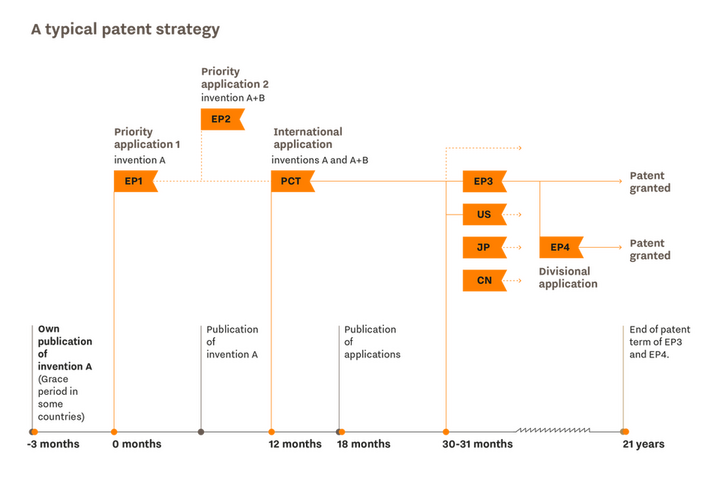
When applying for patent protection in multiple countries, it is important to proceed strategically, starting with a priority application, for example. This article uses an illustrative diagram to explain the steps involved in the process, from the priority application to subsequent applications and divisional applications, and explains the role of the grace period.
A
typical
patent
strategy
Priority
If you want to obtain patent protection in several countries, it is not necessary to file patent applications in different countries immediately. Usually, a filing strategy starts with one initial patent application, which is called the priority application. In the diagram, this is the European application EP1, in which invention A is claimed. After filing the priority application, you can file one or more subsequent applications within twelve months, claiming the priority of the first application. The date on which the priority application was filed is then also considered the relevant date for assessing the novelty and inventiveness of the subsequent application. In the diagram, the publication of invention A during the priority year therefore has no influence on the assessment of EP1 or subsequent applications.
Multiple priority applications
In complex development processes, it is possible to file multiple priority applications and claim priority for them. This is a good strategy if you continue to develop the invention during the priority year and there is a risk that relevant publications will appear during the priority year. In the diagram, for example, the second priority application (EP2) describes invention A+B.
Grace period
Sometimes an inventor may (accidentally) disclose their invention before a patent application has been filed. In some countries, a so-called grace period serves as a safety net. The disclosure by the inventor(s) themselves is then not taken into account in the assessment of the novelty and inventiveness of a subsequent patent application. In the United States and Japan, a grace period of twelve months after such disclosures usually applies. The German utility model also has a relevant grace period of six months for own disclosures. There are no grace periods for European patent applications, so caution is still advised when disclosing the invention.
“For a divisional application, the relevant date is the filing date of the parent application.”
Subsequent applications
The most commonly chosen subsequent application is a PCT application. The Patent Cooperation Treaty (PCT) allows you to obtain protection in one or more of the 150 member countries through a single international application. However, a PCT application does not lead to a global patent. No later than approximately 2.5 years after filing the priority application, the PCT application can be continued as separate applications in one or more of the member countries and regions. In the diagram, a further European patent application (EP3) has been chosen, as well as separate applications in the United States, China, and Japan. It is important to note that some countries are not members of the PCT. Examples include Taiwan, Argentina, and some smaller jurisdictions. For these countries, separate applications must be filed at the end of the priority year.
Divisional applications
In most countries, it is possible to file a divisional application (also known as a child application) while the parent application is still pending. In the diagram, EP4 is a divisional application that was filed before the parent application EP3 was granted. Divisional applications can be used, for example, to obtain broader or narrower patent protection than for the parent patent. This can help to better protect your own commercial product or that of your competitor.
Term of a patent
The maximum term of a patent is usually twenty years, calculated from the filing date. Has priority been claimed? Then the term starts from the filing date of the subsequent application. For a divisional application, the relevant date is the filing date of the parent application.
Want to know more?
Read the webpage ‘How to manage intellectual property strategically”
Share


Poll
Wat gaat het nieuwe octrooisysteem (UPC) voor mij betekenen?
Als het UPC en unitair octrooi worden ingevoerd, zal ik:
voor mijn bestaande en nieuwe EU octrooien waarschijnlijk kiezen voor UPC
25%
voorlopig nog het huidige systeem volgen en eerst de UPC-ontwikkelingen afwachten
25%
niet weten wat het beste is om te doen
25%
Kies uw antwoord en zie de reacties van andere lezers!
Lees meer over het UPC en het unitair octrooi.